As we look at Craft and Structure Anchor Standards 4, 5, and 6 for K-1 learners, it reminds us that we are building the foundation. Let’s take a closer look at each standard and think about what it looks like in the K-1 classroom
Kindergarten Anchor Standard 4 Ask and answer questions about unknown words in a text.
One strategy that is part of emergent reading instruction in many classrooms is called the unknown word strategy. This strategy gives students the tools to figure out unknown words. There are different versions of the strategy, but most have basic common elements. Students are taught to look at the picture and think about the story they are reading. Next they are prompted to say the beginning sound and slide under the word or read to the end of the sentence. Lastly they are asked to try a word and determine if it makes sense, looks right and or sounds right. In addition, students may be asked to try a different vowel, chunk parts of the word or look for a rhyme pattern they know. This standard is the same for both reading literature and informational text.
First Grade Anchor Standard 4 Identify words and phrases in stories or poems that suggest feelings or appeal to the senses.
For emergent readers, a print rich environment is extremely important. Students have four vocabularies ( reading, writing, listening and speaking). When they enter school, their listening and speaking vocabularies are most developed. Word banks help to capture their listening and speaking vocabularies using a symbolic graphic that will help students to organize the words for use in their reading and writing vocabularies. Word banks can be seasonal, thematic and or content specific. Below are three different word banks created in K-1 classrooms.


The ghost word bank is for the letter of the week. (g) The kite word bank is organized alphabetically like a word wall. The pumpkin word bank has monthly or seasonal words.

Words can be collected for each of the five senses and are always available to the students to add words as they encounter them in their reading. See the purple chart. The same graphic format could be made to collect words that suggest feelings.

Color word choices on crayons help to increase color word choice language.
The book, “My Five Senses” by Aliki is a good survey of the senses. It can become a good place to start collecting sensory words for the chart pictured above.
As teachers, our read aloud choices play an important role. This is where we can choose literature selections that have phrases that are filled with feelings and emotions. Here are a few examples from a picture book called “Sister Anne’s Hands” by Marybeth Lorbiecki.
“She said with sparkles in her voice”. “Puppy brown with white lacy moons”. “A light pretty pink like an evening dress for Barbie”. “Sister’s face froze like a tongue on an icy post”. “You could have heard a butterfly sigh for the rest of the day”.
Just imagine the interesting conversations you could have with the students. What do you think sparkles in your voice would sound like? What do you think that means? What do you think a butterfly sigh would sound like? Turn to your elbow partner and share your best butterfly sigh. What words would go on our feelings or five senses chart? Where would we put the word sigh?
Another selection for sensory words is “Frederick” by Leo Lionni. When the mice ran out of supplies for the winter they called on Frederick to share about the sun rays, colors and words he collected. Here are a few examples. “Now I send you the rays of the sun. Do you feel their golden glow?” “Close your eyes again. Listen. Red poppies in the yellow wheat.” “Who scatters snowflakes? Who melts the ice?” What words from these phrases suggest feelings or appeal to the senses?
Feeling Mentor Texts: When Sophie Gets Angry, Really, Really Angry … by Molly Bang, My Many Colored Days by Dr. Seuss, Feelings by ALIKI, Sometimes I’m a Bombaloo by Rachel Vail, Glad Monster, Sad Monster A Book About Feelings by Ed Emberley & Anne Miranda
Craft and Structure Anchor Standard 5: Kindergarten: Recognize common types of texts ( e.g., storybooks, poems) Identify the front cover, back cover, and title of a book.
First Grade: Explain major differences between books that tell stories and books that give information, drawing on a wide reading of a range of text types. Know and use various text features (e.g., headings, tables of contents, glossaries, electronic menus, icons) to locate key facts or information in a text.
To help students recognize different types of texts we can think about how we organize books within the classroom. Traditionally we might organize books by themes, authors, alphabetically, seasons, and by genres. Making labeled book tubs with literature currently in use in the classroom may help students to notice the differences. You can purchase colorful plastic tubs from dollar stores that will make excellent book pots.

To help students explain common text types and major differences between books, make three big charts. The titles for the charts are “What we know about Poems”, “What we know about Stories”, and “What we know about Non-fiction”.
Select a big book in each area to read and discuss with the children. Bring the students to the floor with the book and chart. As you read, stop and talk about the story elements, text features and poetic forms. List and record the information on the chart. Repeat the process until all three texts types are done.
Review the charts often and add new features as you see them in other texts. Below are three charts developed after reading a genre specific text.


Compare texts by sorting texts in the labeled book pots. Say, ” Where did you put it?” and “How did you know?” The brainstorming activity above should give the students the information they need to sort the books correctly.
Another strategy to help students recognize and explain the differences between text types is to build a physical bar graph. After library, ask the students to line up and start to sort their library books. “What type of book is this and how do you know?” Students can agree or disagree and explain their thinking. The completed bar graph reflects what the students are reading and what you have read to them. A sample of this activity is pictured below.

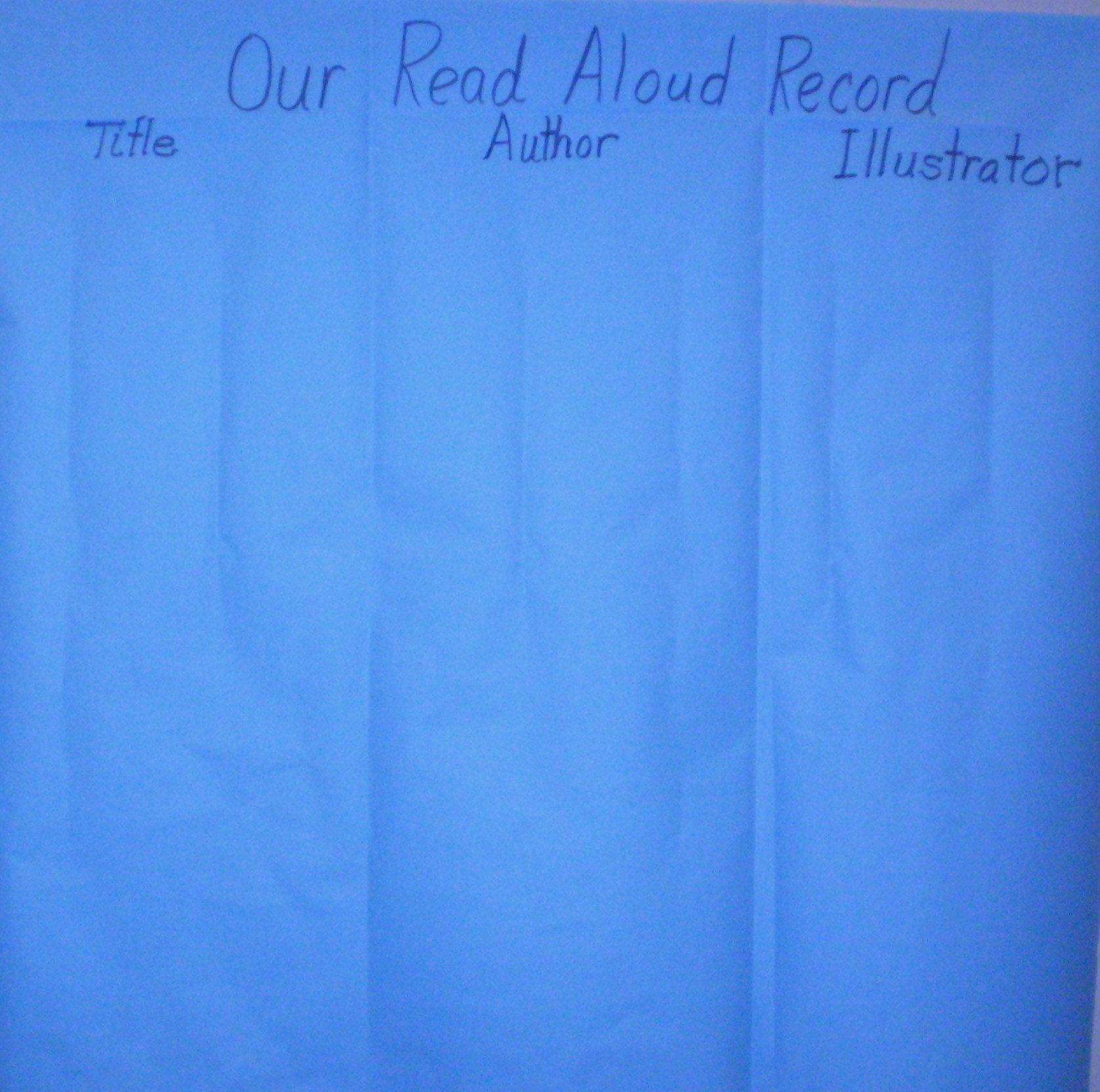
When reading to the students and around the reading table, conversation about the author and illustrator is part of teaching concepts about print. To help students understand the roles and the different language for each role start a read aloud record. The students can write the names of the authors and illustrators as they appear in the text. Language like, as told by, retold by, written and illustrated by, photography by, pictures by, and drawn by, help students to recognize there is more than one way to say author and illustrator. See the chart format below.
Concepts about print also include, knowing the front and back cover of a book. Students tell the title as well as the author and illustrator. They learn the difference between pictures, words, and spaces between words. They are taught directionality, where to start reading on a page as well as punctuation.
To identify who is talking during different parts of the story, color coded reader’s theater is a good strategy. Take an emergent reader’s theater with multiple characters. Highlight each character in a different color. Students are assigned a part and read only the colored text that matches their character. They can read in different character voices as well.
